Injury Risk by Sport: Train Smarter and Stay Healthy
Train Smart, Stay Injury Free: Comparing Injury Risk Across Sports and Training Smarter
Different sports stress the body in different ways—impact, speed, contact, repetition, or awkward landings. Understanding the typical injury patterns and risk drivers by sport helps build a training plan that improves performance without collecting preventable setbacks. The goal isn’t “zero risk” (no sport offers that), but a smarter approach to load, technique, and recovery so training stays consistent.
Why injury risk varies so much from one sport to another
Two athletes can train just as hard and still face very different injury odds depending on what the sport demands.
- Contact vs. non-contact: Collisions and tackles raise acute injury risk, while non-contact sports often trend toward overuse problems that build gradually.
- Impact and landing demands: Running and jumping load bones, tendons, and joints differently than cycling or swimming, which are generally lower impact.
- Change-of-direction and pivoting: Cutting sports increase ligament strain and ankle sprain risk, especially when fatigue changes foot placement and knee alignment.
- Repetition and volume: High weekly mileage, high serve counts, or high throwing volume can outpace tissue recovery and tip into overuse injuries.
- Rules, surfaces, equipment, and skill level: Footwear, field conditions, protective gear, and technique quality can swing risk quickly—even within the same sport.
Common injury patterns by sport (and what usually drives them)
Running
Running injuries often show up in the lower leg and knee: shin pain, Achilles/plantar fascia irritation, and “runner’s knee.” The most common driver is a sudden jump in weekly volume or intensity—especially when strength, sleep, and easy days don’t keep up.
Soccer and basketball
These sports combine speed, cutting, jumping, and (in soccer) more contact. Ankle sprains and knee ligament injuries are common, and risk rises with fatigue, messy landings, and limited sprint/strength preparation. Hamstring strains also appear when athletes aren’t exposed to enough progressive high-speed running.
Tennis and racquet sports
Repetition is the theme: shoulder irritation, tennis elbow, and wrist pain can build from high stroke volume, grip choices, and technique inefficiencies. When serve volume spikes—or when strength isn’t balanced across the shoulder girdle—tissues get overloaded.
Swimming
Swimming is low-impact, but high-volume strokes can irritate the shoulder (“swimmer’s shoulder”). Limited thoracic mobility, poor scapular control, and sudden jumps in yardage or intensity often contribute.
Cycling
Cycling is also lower impact, but it’s very fit-dependent. Knee pain, low back discomfort, and neck strain commonly relate to bike setup, sustained posture, cadence habits, and ramping training too quickly (especially hills or hard intervals).
Strength training
Strength training risk is variable because it depends heavily on load management and technique. Strains, tendinopathies, and low back flare-ups become more likely when weights jump too quickly, form breaks down late in sets, or recovery is limited.
Sport-by-sport snapshot: relative risk, typical injuries, and prevention focus
| Sport | Relative risk profile | Common issues | High-impact prevention focus |
|---|---|---|---|
| Running | Moderate (overuse-heavy) | Shin pain, Achilles/plantar issues, runner’s knee | Gradual mileage, strength (calf/hip), sleep and recovery |
| Soccer | High (contact + cutting) | Ankle sprains, ACL injuries, hamstring strains | Neuromuscular warm-up, sprint exposure, landing/cutting mechanics |
| Basketball | High (jump + cutting) | Ankle sprains, patellar tendinopathy, ACL injuries | Jump/landing training, ankle stability, workload management |
| Tennis | Moderate (repetition-heavy) | Tennis elbow, shoulder irritation, wrist pain | Technique check, grip/load balance, rotator cuff/scap strength |
| Swimming | Lower impact (overuse possible) | Swimmer’s shoulder, neck strain | Stroke volume control, mobility, scapular endurance |
| Cycling | Lower impact (fit-dependent) | Knee pain, low back/neck discomfort | Bike fit, cadence habits, hip mobility and trunk endurance |
| Strength training | Variable (load-dependent) | Strains, tendinopathy, low back flare-ups | Progressive overload, technique consistency, deloads |
How to train smarter in any sport: a practical injury-risk checklist
Who benefits most from a sport-specific injury-risk guide
Practical ebook: sport-by-sport injury risk insights for safer training decisions
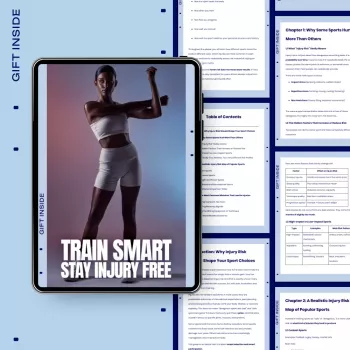
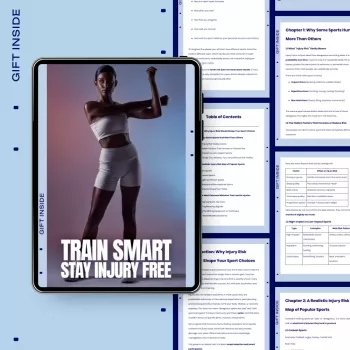
If comparing sports and building a safer plan feels overwhelming, a simple reference can help keep decisions consistent week to week. Train Smart Stay Injury Free — Practical Ebook on the Injury Risk of Different Sports for Smarter, Safer Training is designed to help compare how different sports tend to injure athletes and what training choices reduce risk. It’s useful for setting realistic expectations: which injuries are common, which are more preventable, and which signals mean “back off.”
Helpful extras for everyday training consistency
- Wear What Works Together – Color Matching Guide for Outfits, Personal Style, and Confident Everyday Dressing | Digital Download (a quick way to simplify daily choices on busy training days).
- Elegant V-Neck Short Winter Coat for Women (useful for warm layers on cold-weather walking warm-ups or post-session cooldowns).
Evidence-based resources to learn more
- American College of Sports Medicine (ACSM) — Exercise and Injury Prevention Resources
- NHS — Sports injuries
- CDC — Sports-Related Injuries
FAQ
Which sports have the highest injury risk?
Collision and cutting sports (like soccer, basketball, football, and rugby) tend to carry higher acute injury risk because speed, pivots, and contact combine. Overuse-heavy sports can also accumulate injuries when weekly volume grows faster than recovery, so smart progression and preparation can shift risk significantly.
How can training be increased without getting injured?
Change one variable at a time (volume or intensity), schedule easy days to absorb hard sessions, and include strength work to build tissue capacity. Deload every few weeks, and treat rising pain, worsening soreness, or persistent fatigue as cues to adjust early.
Is cross-training safer than sticking to one sport?
Cross-training can reduce repetitive stress by spreading load across different tissues while maintaining fitness. It can also add total workload, so it’s safest when total weekly intensity is tracked and high-impact days are balanced with lower-impact sessions.











Leave a comment